Most first-time visitors to the UAE see the malls, the beaches and the skyline, and leave thinking the country is mostly glass and sea. Yet a short drive inland reveals a completely different place: red dunes, limestone outcrops, dry riverbeds and mountain villages where life moves at a much slower pace. Exploring that side of the Emirates is easier than many people expect, as long as you have the right vehicle and a little planning.
That is where the Jeep comes in. For many independent travellers, a Jeep Wrangler rental Dubai is the starting point for an adventurous few days: it looks the part, sits high above the road and inspires confidence on uneven tracks. Below are three stops that make a satisfying loop, followed by a closer look at why the Wrangler keeps turning up in travellers’ photos.
Stop one: Hatta
Tucked into the Hajar Mountains near the border with Oman, Hatta is Dubai’s mountain enclave and the easiest of the three stops to reach. The drive from the city is on good paved roads, so you do not need any off-road skills to get there.
Once you arrive, there is plenty to do. Paddle a kayak on the emerald waters of Hatta Dam, wander through the restored heritage village with its watchtowers and stone houses, or follow one of the hiking and mountain biking trails that wind through the hills. Honey lovers should look out for local beekeeping, a tradition the area is known for. In the cooler months, camping and glamping sites fill up quickly, so book a night if you can. Waking up in the mountains and watching the sun hit the ridges is one of the quieter pleasures of the UAE.
Stop two: the Fossil Rock area
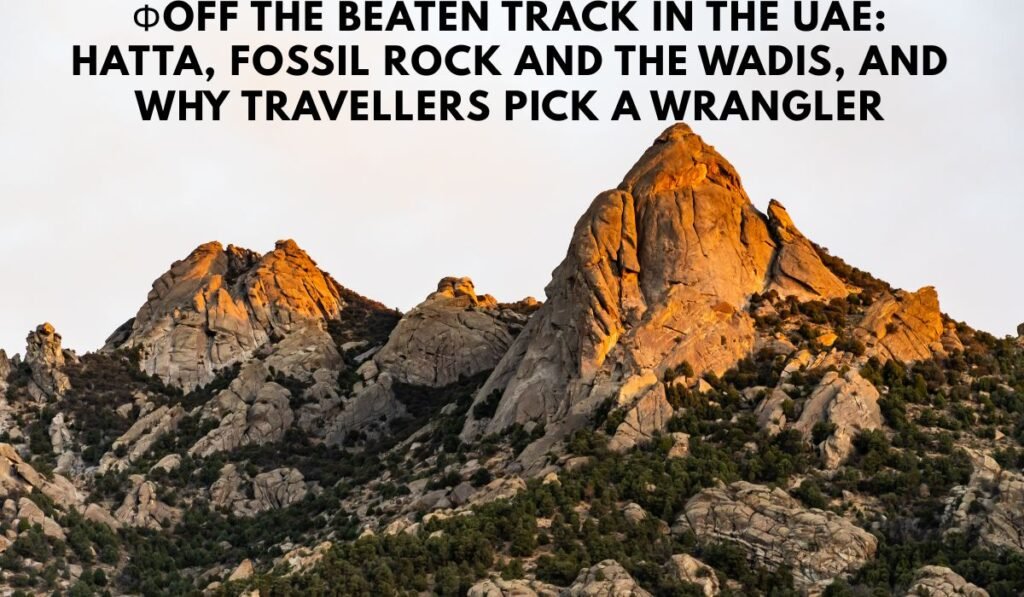
Head back towards the interior of Sharjah and you reach one of the most striking landscapes in the region. Fossil Rock, known locally as Jebel Maleihah, is a limestone outcrop rising from the dunes, and its surface holds marine fossils from a time when this desert lay under the sea. The surrounding area around Mleiha is rich in archaeology too, with sites that tell the story of people who lived here thousands of years ago.
The sand around Fossil Rock is soft and the dunes can be tricky, so this is not the place to experiment on your own. Many visitors join a guided tour from the local archaeological and heritage centre, where experienced drivers handle the dunes and guides explain what you are looking at. That is the approach we recommend for anyone new to sand driving. Even with a capable 4×4, deflating tyres, reading dune crests and recovering a stuck vehicle are skills that take practice.
Stop three: the wadis
Wadis are dry riverbeds that carve through the mountains, filling with water only after rare rains. They are some of the most photogenic places in the country. Wadi Shawka, in the foothills of Ras Al Khaimah, is a favourite: a small dam, rocky paths, hiking trails of varying difficulty and, in the cooler season, a peaceful atmosphere that feels far from the coast.
Access roads to the main wadi areas are often paved or well-graded, and many trailheads can be reached in an ordinary car. Going further along gravel tracks is where a high-clearance vehicle becomes genuinely useful. Always check the weather before setting out: wadis can flood quickly after storms, even when the sky above you looks clear, and it is never worth crossing running water.
Why travellers pick a Wrangler
There are many capable SUVs in the UAE, but the Wrangler has a special place among adventurous visitors. A few reasons stand out.
- Ground clearance and short overhangs. It clears rocks, ruts and steep entry points that would make a regular car nervous.
- Proper four-wheel-drive hardware. The Wrangler is built around off-road capability rather than adding it as an afterthought.
- Open-air character. Many versions have removable roof panels, which makes mountain mornings and desert sunsets feel even more immersive.
- A sense of occasion. Let’s be honest, it simply looks right parked in front of a mountain backdrop.
There are trade-offs, of course. On the highway, a Wrangler feels more rugged than refined, with more wind noise than a typical SUV. Cabin and luggage space are adequate rather than generous. For a group that will mostly stick to paved roads, a conventional SUV might be more comfortable.
Driving responsibly beyond the asphalt
The most important rule is simple: off-road driving only where it is permitted, and only within the terms of your rental. Rental companies set their own conditions, and some do not allow their vehicles to leave paved roads at all, even if the car is technically capable. Read the agreement before you head out, and if desert driving is the main goal, book a guided dune tour instead of trying it solo in a rental. Protected areas, private land and archaeological sites all have their own rules, so stick to marked tracks.
Plan your route around where you want to start. If Fossil Rock and the eastern deserts are high on your list, consider picking up a car closer to the action. Yango Drive operates in Dubai, Abu Dhabi and Sharjah, which gives you some freedom to choose a base. For those staying near the northern emirates or arriving at Sharjah airport, searching for car rental in Sharjah can save a good chunk of driving time on the first morning.
Pack more water than you think you will need, keep your phone charged, tell someone where you are going, and start early to avoid the midday heat. The interior of the UAE rewards travellers who take it slowly: a fossil found on a rock face, the silence of a wadi at dawn, the first glimpse of the dam at Hatta after a long, winding road. Those moments rarely make it onto the postcards, which is exactly why they are worth the drive.